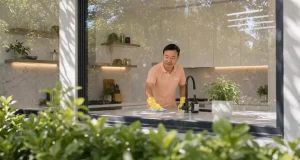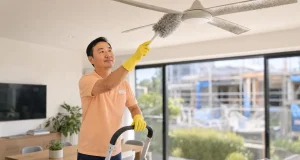
You cleaned the house properly on Saturday. Not a quick once-over. A real clean.
By Tuesday, it already looks off.
Fan blades collecting that fuzzy layer again. Bathroom smells slightly damp. Kitchen bench feels like it’s got a film on it.
That gap between effort and result should not be that small.
But in Brisbane, it is.
You are not bad at cleaning. You are just up against a climate that quietly undoes your work every single day.
How Brisbane’s High Humidity Defeats Standard Cleaning
Here is what most people don’t realise: dust behaves differently in a sub-tropical city.
In a dry climate, dust is light and loose. A vacuum and a wipe sends it packing. Brisbane sits in that 60 to 70 percent humidity range through summer. At that level, dust doesn’t float. It absorbs moisture, gets heavy, and sticks.
That grime on your ceiling fan isn’t sitting there. It’s bonded. The build-up in your window tracks has packed in like wet clay. The film on your skirting boards needs real agitation and the right cleaning chemistry to lift, not just a damp cloth dragged across it.
A quick vacuum-and-spray routine cannot compete with high humidity house cleaning. What you need is frequency, correct method, and the right products applied in sequence. That is the difference between a clean that holds and one that’s undone by Thursday.
“In Brisbane, dust doesn’t settle. It sticks. That one fact changes everything about how you need to approach cleaning your home.”
The Hidden Cost of Moisture: Mould, Mildew, and Musty Odours
Let’s talk about what is actually growing behind your shower caddy.
Brisbane homes do not need a flood to develop a mould problem. They just need a few overcast days and the wrong amount of airflow. After just a few consecutive days of rain, mould can begin growing on walls, ceilings, and benches because of the heavy, saturated air.
The spots that catch people off guard are never the obvious ones. It’s:
- The grout lines you haven’t scrubbed in a month
- The back wall of a built-in robe pushed against an external brick wall
- The silicone seal along the base of the bath
- Under the bathroom vanity where no airflow reaches
- Behind furniture that hasn’t moved since you arranged the room
When indoor humidity climbs above 50 percent, symptoms like coughing, respiratory infections, and a stuffy nose become common. For households with kids, elderly residents, or anyone with asthma, that is not a minor inconvenience. It is a recurring health problem with a very preventable cause.
Exhaust fans help. A dehumidifier helps. But existing mould problems must be addressed before relying on a dehumidifier, and ongoing cleaning and maintenance remain essential. These tools slow the problem down. A professional cleaner actually stops it.
Working through your wet zones on a weekly or fortnightly schedule interrupts the mould cycle before spores can anchor. Grout gets treated. Shower glass gets squeegeed. Silicone seals get wiped before the black creeps in at the edges.
Leave it too long and the numbers get uncomfortable fast. Professional mould remediation in Brisbane can cost anywhere from $500 to $4,000, depending on how far it has spread.
Up to $4,000 to fix a mould problem. A fortnightly cleaner costs a fraction of that, annually.
Air-Conditioning Grime: The Summer Hangover
Most Brisbane households run their split-system units for six months straight. Some run them all year.
Every time your AC kicks on, it pushes the same mix back into the room. Dust, skin, grease, spores. You clean it. It comes back. Not because you missed it. Because it never stopped circulating.
In Brisbane’s climate, contamination begins building up again immediately after a clean. That is not a failure. That is just the physics of living in a sub-tropical city with recirculated air.
The answer is not cleaning harder during your weekend. It is cleaning more often, so build-up never gets a foothold. Regular house cleaning keeps this cycle broken so you are not breathing recycled grime through winter once the AC finally goes off.
There is a longer-term case here too. Well-maintained air conditioners in Brisbane last 10 to 15 years. Neglected systems fail after 8 to 10 years. The same logic applies to every surface in your home. Consistent maintenance extends the life of materials. Sporadic cleaning does not.
Why Regular House Cleaning is Actually Worth the Investment
This isn’t a luxury. It’s maintenance. And it’s the cheapest version of it you’ll get.
Think about what gets permanently damaged in a Brisbane home when cleaning is inconsistent:
- Shower glass: Hard water minerals deposit every time your shower runs. Cleaned regularly, they wipe off. Left long enough, they etch into the glass. Replacing a shower screen can cost over $2,000.
- Bathroom silicone: In poorly ventilated Brisbane bathrooms, silicone seals can perish within three to five years. Proactive replacement costs around $150. Water damage to the wall framing behind it costs thousands.
- Grout: Once mould colonises grout lines, surface cleaning only removes what you can see. The spores are already in the material. Regrouting a bathroom is not a cheap afternoon project.
Regular cleaning is not a cost. It is the thing that stops the bigger costs from arriving.
Reclaim Your Brisbane Weekends
Here is the reality.
You can keep spending half your weekend chasing a clean that won’t hold, or you can change the rhythm entirely.
In a Brisbane home, the win is not perfection. It’s interruption. Breaking the cycle before humidity, dust, and moisture build momentum again.
That is what a proper weekly or fortnightly clean actually does. It resets the surfaces that matter before things bond, spread, or stain.
Which means your home stays consistently liveable, not briefly perfect.
And your Saturday goes back to being yours.
Frequently Asked Questions
1. My house looks fine. Am I just being sold something?
A clean-looking Brisbane home is not the same as a clean Brisbane home. Mould growth in this climate almost always starts somewhere you are not regularly checking:
- Inside built-in wardrobes against external walls
- Behind furniture that hasn’t moved in months
- In grout lines and silicone seals
- Under bathroom vanities with poor airflow
By the time it is visible, it has already been there a while. A regular professional cleaner is not about appearances. It is about catching the problem before it becomes a remediation bill.
2. I run my AC on dry mode to manage humidity. Does that replace regular cleaning?
Using the dry function on your split-system is genuinely smart in Brisbane. It reduces airborne moisture and slows mould development. But it does not:
- Remove grime and dust already bonded to surfaces
- Clean the wet zones where spores are already established
- Treat grout, silicone, or glass
Think of dry mode as one layer of defence. Regular professional cleaning is another. You need both working together to stay ahead of Brisbane’s climate.
3. What is actually different about weekly versus fortnightly cleaning in Brisbane?
Weekly cleaning catches sticky dust before humidity has time to bond it to surfaces. Grout and silicone get treated before mould spores anchor. Glass gets squeegeed before mineral deposits begin to etch.
Fortnightly is better than nothing, but you will notice the climate catching up between visits, particularly in bathrooms and on ceiling fan blades. If anyone in your household has allergies, asthma, or respiratory sensitivities, weekly is worth the step up.
4. Can hard water still damage my shower glass if I squeegee it every day?
Yes, and this one catches a lot of people out. Squeegeeing after every shower is excellent practice and significantly slows mineral build-up. But Brisbane’s tap water still carries dissolved calcium and magnesium that leave trace deposits even with good technique.
Over years, those deposits accumulate in the microscopic surface of the glass and begin to etch it. Once that happens:
- Household cleaners cannot reverse it
- The damage is structural, not just surface grime
- Restoration is possible but costs money; replacement costs significantly more
Regular professional cleaning with the right products stops the etching cycle before it starts.
5. I live in a modern apartment with excellent ventilation. Do I still need regular cleaning?
Modern apartments are often more sealed than older homes, which changes how moisture behaves inside. Without consistent airflow, cooking steam, shower humidity, and general moisture sit in the space longer than most residents realise.
Split-systems help, but without someone regularly cleaning:
- Air return areas around filters where grime accumulates
- Kitchen splashbacks where grease and steam combine
- Bathroom grout and silicone in sealed wet rooms
…you are still dealing with Brisbane’s climate, just in a more contained space. Good ventilation reduces the problem. It does not eliminate it.
Brisbane House Cleaners can help you stay ahead of humidity, dust, and moisture before they become bigger problems. We service New Farm, Paddington, Bardon, Clayfield, Windsor, Hamilton, Ashgrove, Newstead, Indooroopilly, and Kangaroo Point. Get a free house cleaning quote or contact our team to arrange a cleaning routine that suits your home.